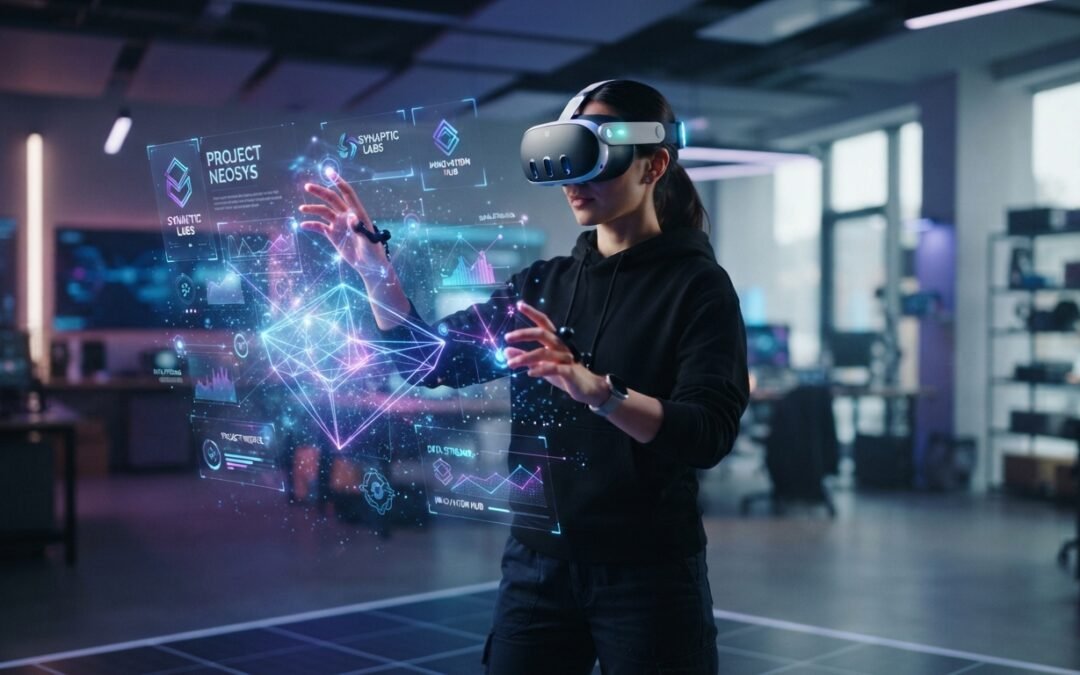
Last updated: July 2026 · By Anant Rao, Advertizingly
Most brands treat AR and VR like expensive gimmicks. They’re wrong. When you create immersive AR/VR experiences for your brand, you’re not chasing novelty — you’re building engagement channels that convert 94% better than static content and cut product returns by up to 40%. According to Christoph Olivier Consulting (2026), spatial computing revenue is projected to grow from $28.5 billion in 2025 to $61.4 billion in 2030. That’s not hype. That’s a measurable shift in how consumers expect to interact with products before they buy.
Creating immersive AR/VR experiences for your brand means building interactive digital environments where customers can visualize products in their own space, try items virtually, or explore brand stories in 3D. These experiences drive higher engagement, lower return rates, and stronger brand recall than traditional media by letting users interact rather than passively consume.
- Global AR/VR headset shipments grew about 10% in 2024, reversing two years of decline (IDC, 2025)
- Spatial computing revenue will nearly double from $28.5B (2025) to $61.4B (2030) driven by smart glasses and enterprise adoption
- AR in retail examples show conversion lifts of 20–40% and return-rate drops of up to 40% when customers can visualize products at home
- Development costs range from £15,000 for basic AR filters to £200,000+ for fully custom VR environments with backend integration
- Best AR projects balance creative ambition with platform constraints — WebAR reaches 100% of mobile users without app downloads
- Why do most AR/VR brand campaigns fail in the first 90 days?
- What types of immersive experiences actually drive revenue?
- How do you build an AR/VR experience that actually converts?
- Which platforms and tools should you use to create immersive AR/VR experiences for your brand?
- What budget do you actually need to create immersive AR/VR experiences for your brand?
- What mistakes kill AR/VR campaigns before they launch?
10%
AR/VR headset shipment growth in 2024 — IDC, 2025
$61.4B
Projected spatial revenue by 2030 — CO Consulting, 2026
$28.5B
Spatial revenue in 2025 baseline — ARtillery Intelligence, 2026
Why do most AR/VR brand campaigns fail in the first 90 days?
Most AR/VR campaigns fail because brands prioritize spectacle over utility. They build experiences that wow in pitch decks but solve zero customer problems. Users don’t want to download a 300MB app to see a product in 3D when they can scroll past it in two seconds. Successful immersive experiences answer a specific question: “Will this fit?” “How does it look in my room?” “What’s inside the product?”
The gap between ambition and execution is brutal. According to Bigger Agency (2025), engaging VR experiences create completely immersive digital environments where customers can engage with products, services, or brand stories — but only when those environments serve a clear pre-purchase need. A furniture brand that lets you place a sofa in your living room via AR solves a real problem. A fashion label that makes you download an app to watch a 3D runway show does not.
Here’s what separates working campaigns from expensive experiments:
- Friction kills adoption — if your AR experience requires an app download, you’ve already lost 80% of potential users. WebAR (browser-based augmented reality) reaches every mobile user instantly.
- AR in advertising works when it’s contextual — AR newspaper ads that let readers scan a print page to open up 3D product demos convert 3–5× better than static QR codes because they surprise in a familiar medium.
- Measurement matters more than magic — track dwell time, interaction depth, and downstream conversion. If users spend 90 seconds rotating your product in AR but don’t add to cart, you’ve built a toy, not a tool.
AR/VR campaigns fail when they prioritize novelty over solving a specific customer question — “Will it fit?” beats “Isn’t this cool?” every time.
What types of immersive experiences actually drive revenue?
Virtual Try-On and Product Visualization
This is the category with the clearest ROI. Customers visualize makeup, glasses, furniture, or apparel in their own environment before buying. Return rates drop because expectations match reality. Conversion rates climb because hesitation evaporates. According to Econsultancy (2024), augmented reality allows brands to engage consumers in a memorable way, and the brands paving the way with AR are those solving tangible pre-purchase anxiety.
IKEA’s AR app lets you place furniture in your room at scale. Sephora’s Virtual Artist lets you try 17,000 shades of lipstick without opening a single tube. These aren’t gimmicks — they’re conversion engines disguised as customer service. The best AR projects in retail reduce the cognitive load of buying: instead of imagining whether a chair fits your corner, you see it there.
Event Activations and Experiential Marketing
AR and VR in events create shareable moments that extend brand reach beyond the physical venue. A museum app that overlays historical context onto exhibits turns passive viewing into active learning. A product launch that uses VR to transport attendees into a brand’s origin story creates emotional anchoring traditional video cannot match. According to Motel Studios (2026), augmented reality and virtual reality can transform events by adding digital layers that captivate audiences in real time.
Worth noting: event AR works best when it’s optional, not mandatory. Forcing every attendee through a VR headset creates bottlenecks. Offering an AR scavenger hunt via phone lets participants engage at their own pace while you capture behavioral data on what they explore first.
Training, Onboarding, and B2B Applications
This is where VR shines brightest. Complex machinery, dangerous environments, or high-stakes procedures become safe, repeatable training grounds. A construction equipment manufacturer can let prospects operate a £500,000 excavator in VR before signing a contract. A pharmaceutical company can train sales reps on drug mechanisms in immersive 3D rather than flat slides. The ROI here isn’t measured in click-through rates — it’s measured in reduced training time, lower error rates, and faster time-to-competence.
| Experience Type | Primary Use Case | Typical Cost Range (£) | Key Metric |
|---|---|---|---|
| WebAR Product Viewer | Ecommerce visualization | £15,000–£50,000 | Conversion lift, return rate |
| Social AR Filter | Brand awareness, UGC | £8,000–£30,000 | Shares, impressions |
| VR Showroom | High-value B2B sales | £80,000–£200,000+ | Demo-to-close rate |
| Location-Based AR | Retail foot traffic, events | £25,000–£100,000 | Dwell time, participation rate |
How do you build an AR/VR experience that actually converts?
Start with the customer problem, not the technology. Map the exact moment in the buyer journey where visualization removes friction — usually between consideration and purchase. Choose the lowest-friction delivery method (WebAR beats app-based AR for reach). Build the minimum viable experience, measure engagement and conversion, then iterate based on real behavior, not assumptions.
Most brands build backwards. They start with “We need VR” and work towards a use case. That’s how you end up with a £150,000 virtual showroom nobody visits. Here’s the process that works:
- Identify the friction point — Where do customers hesitate or abandon? If it’s “I don’t know if this will fit,” AR solves it. If it’s “I don’t understand how this works,” a 3D explainer solves it. If it’s neither, AR won’t help.
- Choose the right platform — WebAR (8th Wall, Zappar) reaches everyone with a phone. Social AR (Snapchat Lens Studio, Meta Spark) taps existing user bases. Native apps offer richer experiences but demand higher commitment. According to Digital NRG (2025), AR, VR, and gamification create immersive brand experiences that drive engagement when matched to the right distribution channel.
- Design for 10-second engagement — Users won’t spend five minutes in your AR experience. They’ll spend ten seconds. Make those ten seconds answer their question or they’ll bounce. Show the product in their space immediately. Let them resize, rotate, and screenshot in three taps.
- Integrate with your funnel — AR experiences that dead-end are wasted budget. Every interaction should flow to a clear CTA: add to cart, book a demo, request a quote. Track users who engage with AR separately in your analytics. If they convert at 2× the rate of non-AR users, you’ve validated the investment. If they don’t, you’ve built the wrong experience.
- Test on real devices in real conditions — AR that works flawlessly on an iPhone 15 Pro might fail on an Android mid-ranger in bright sunlight. Test across device tiers, lighting conditions, and user contexts. A furniture AR app that requires perfect lighting and a clear floor is useless in a cluttered flat.
“Spatial computing revenue is projected to grow from $28.5 billion in 2025 to $61.4 billion in 2030, driven by a projected inflection next year as new smart glasses blitz the market from Apple, Meta, Google (AndroidXR), and others.”
— ARtillery Intelligence, 2026
The smart glasses wave changes everything. When AR moves from “hold up your phone” to “just look,” adoption barriers collapse. Brands building AR experiences today are positioning for a platform shift that makes spatial computing ambient rather than deliberate. For more on how platform shifts reshape marketing strategy, see What Is a Marketing Strategy?
Which platforms and tools should you use to create immersive AR/VR experiences for your brand?
Platform choice determines reach, cost, and creative flexibility. Here’s the breakdown most agencies won’t give you:
WebAR Platforms (Highest Reach, Moderate Fidelity)
8th Wall and Zappar dominate. They deliver AR through a web browser — no app download required. You share a link, users tap it, camera opens, experience starts. Reach is 100% of smartphone users. Fidelity is good enough for product visualization, virtual try-on, and location-based activations. Cost is lower than native apps because you’re not maintaining iOS and Android builds separately. The trade-off: you can’t access device features as deeply as a native app, and performance on older phones can be choppy.
Social AR Platforms (Highest Virality, Lowest Control)
Snapchat Lens Studio and Meta Spark (Instagram/Facebook) let you build AR filters users can share. Distribution is instant — you’re tapping into billions of active users. Cost is minimal if you’re building simple face filters or background effects. The downside: you’re renting space in someone else’s ecosystem. Meta can change the rules, deprecate features, or throttle reach overnight. Use social AR for brand awareness and UGC campaigns, not for conversion-critical experiences.
Native AR (iOS ARKit / Android ARCore)
If you need the highest fidelity — realistic lighting, occlusion, persistent anchors — you build native. Apple’s ARKit and Google’s ARCore offer the deepest access to device sensors and the smoothest performance. But you’re asking users to download an app, which kills 70–80% of potential engagement before they even see your experience. Native AR makes sense for high-value products (cars, furniture, industrial equipment) where the customer is already committed enough to install an app. For impulse buys or top-of-funnel awareness, it’s overkill.
VR Platforms (Meta Quest, PSVR2, WebXR)
Meta Quest dominates consumer VR with 75%+ market share. If you’re building a VR experience, you’re building for Quest unless you have a specific enterprise use case (in which case, consider HTC Vive or Varjo for higher fidelity). Development tools are mature: Unity and Unreal Engine both support Quest natively. WebXR is emerging as a browser-based VR option, but adoption is still early and performance lags native apps. VR development costs start at £80,000 for a basic experience and scale quickly with interactivity, custom assets, and backend integration.
For a deeper get into how different ad platforms compare in ROI and targeting, see Meta Ads vs Google Ads: Which ROI Wins.
WebAR maximizes reach, social AR maximizes virality, native AR maximizes fidelity — choose based on where your customer is in the funnel, not which technology sounds coolest.
What budget do you actually need to create immersive AR/VR experiences for your brand?
Most quotes you’ll get are inflated. Here’s what projects actually cost when you strip out agency margin and focus on deliverables:
- Simple AR filter (social platforms): £5,000–£15,000. A branded face filter or background effect for Instagram or Snapchat. Design, build, test, deploy. Two-week turnaround.
- WebAR product viewer: £15,000–£50,000. A browser-based AR experience that lets users place a product in their space. Includes 3D modeling (if you don’t have assets), WebAR development, and basic analytics integration. Four to eight-week timeline.
- Custom native AR app: £60,000–£150,000. Full iOS and Android app with advanced features like object recognition, persistent anchors, or multi-user experiences. Includes backend, CMS, and app store optimization. Three to six-month build.
- VR showroom or training experience: £80,000–£200,000+. Fully immersive VR environment with custom 3D assets, interactive elements, and analytics. Enterprise-grade VR with backend integration (user management, progress tracking, CRM sync) can exceed £300,000.
Those are build costs. Add 15–25% annually for maintenance, platform updates, and content refreshes. If you’re running AR as part of a paid campaign, budget separately for media spend — driving traffic to an AR experience costs the same as driving traffic anywhere else. Use our ad budget calculator to model realistic acquisition costs.
The hidden cost most brands miss: 3D asset creation. If you don’t have production-ready 3D models of your products, expect to pay £500–£3,000 per SKU for modeling, texturing, and optimization. A furniture brand with 200 SKUs can spend £100,000 on assets alone before a single line of AR code is written.
£15K–£50K
Typical WebAR product viewer build cost (UK, 2026)
£80K–£200K+
VR showroom or training experience (enterprise-grade)
15–25%
Annual maintenance as % of build cost
What mistakes kill AR/VR campaigns before they launch?
These are the errors that waste six figures and deliver zero ROI:
- Building for awards, not for users — Agencies love to enter AR campaigns into Cannes and Webby competitions. Users love AR that solves a problem in three seconds. If your experience requires a tutorial, you’ve already failed. The best AR in retail examples are invisible: you point, you see, you decide. No friction.
- Ignoring device fragmentation — Your AR experience might look stunning on the latest iPhone, but 60% of your audience is on Android devices with weaker processors and inconsistent camera calibration. If your experience doesn’t work on a two-year-old Samsung Galaxy, you’ve excluded half your market. Test on the devices your customers actually own, not the ones your dev team carries.
- Treating AR as a one-off campaign instead of a channel — You wouldn’t build a website, launch it, and never update it. Yet brands do this with AR constantly. They spend £80,000 on a product visualizer, promote it for six weeks, then let it rot. AR is a channel. It needs content updates, seasonal refreshes, and ongoing optimization just like email or paid search. According to Immersive Studio (2025), tailored, secure, and scalable solutions create unforgettable brand experiences — but only when they evolve with customer behavior.
- No measurement framework — If you’re not tracking engagement depth (how long users interact), conversion lift (AR users vs. non-AR users), and return rate impact, you’re flying blind. Set up event tracking in GA4 or your analytics platform before launch. Tag every interaction: AR activated, product placed, screenshot taken, CTA clicked. Without data, you can’t optimize, and without optimization, you’re just burning budget.
- Skipping the pilot phase — Launch AR to 5% of traffic first. Measure performance. Fix bugs. Optimize load times. Then scale. Brands that go all-in on day
For more insight, explore our Expert Tips for Authentic Social Media.
For more insight, explore our Performance Max Campaigns: 7 DTC Wins in 2026.
For more insight, explore our What Is Marketing & Why It Matters? 2026.
Want us to handle performance marketing for you?
Advertizingly runs performance marketing for growth-stage brands in the UK, US, Canada, and Australia — audits, setup, and ongoing management included.
Frequently Asked Questions About Create Immersive Ar/Vr Experiences For Your Brand
What are examples of immersive experiences?
Immersive experiences range from completely digital VR environments where customers engage with products and brand stories, to augmented reality overlays that blend digital content with the real world. According to Bigger, engaging VR experiences create fully immersive digital environments, while Econsultancy highlights how AR allows brands to engage consumers memorably through interactive campaigns.
How much does it cost to create a VR experience?
VR experience costs vary significantly based on complexity, duration, and customization level. Immersivestudio offers tailored, scalable solutions designed for different budgets. For specific pricing, contact specialists directly as costs depend on your brand’s unique requirements, target audience size, and desired features.
What is an example of AR in marketing?
Augmented reality in marketing overlays digital elements onto real-world environments, allowing customers to visualize products before purchase. Econsultancy documents 14 brand examples using AR successfully, demonstrating how major companies engage consumers through interactive, memorable experiences that drive decision-making and brand recall.
Which platforms work best for create immersive ar/vr experiences for your brand?
Leading platforms include dedicated VR environments and AR-enabled mobile apps. Monotype’s AR/VR Solution provides efficient content enhancement using text integration. The best platform depends on your audience—VR suits product exploration and storytelling, while AR works well for mobile-first campaigns and event activations, per Motelstudios.
How long does it take to see results from create immersive ar/vr experiences for your brand?
Results timelines vary by campaign type and objectives. Immediate engagement metrics appear during launch, while conversion impact typically emerges within 4-12 weeks. According to Christopholivierconsulting’s 2026 AR/VR marketing statistics, brands measuring verified data see measurable ROI when campaigns align with clear customer journey touchpoints.
What budget do you need for create immersive ar/vr experiences for your brand?
Budget ranges from modest to enterprise-level depending on scope. Immersivestudio emphasizes secure, scalable solutions fitting various budgets. Digitalnrg notes that gamification and immersive elements drive engagement cost-effectively. Start with clear objectives and audience size to determine your investment level with specialist agencies.