

AI-driven personalization is not a feature you bolt on after launch. It is the operating model that separates brands spending ₹50 per click with zero return from those running the same ads at ₹12 CPL and 4.1x ROAS. We have run both kinds of campaigns. The difference is almost never creative quality — it is whether the system knows who it is talking to.
AI-driven personalization uses machine learning to analyze customer behavior, preferences, and intent signals in real time — then automatically adapts ads, emails, landing pages, and product recommendations for each individual. At scale, it replaces manual audience segmentation with dynamic, continuously updated customer profiles that reflect what someone wants right now.
- AI personalization goes beyond demographics — it uses behavioral signals, purchase history, and real-time intent data
- McKinsey research shows it can cut acquisition costs by up to 50% and lift revenue 5–15%
- Most brands fail because they collect data but never activate it intelligently across channels
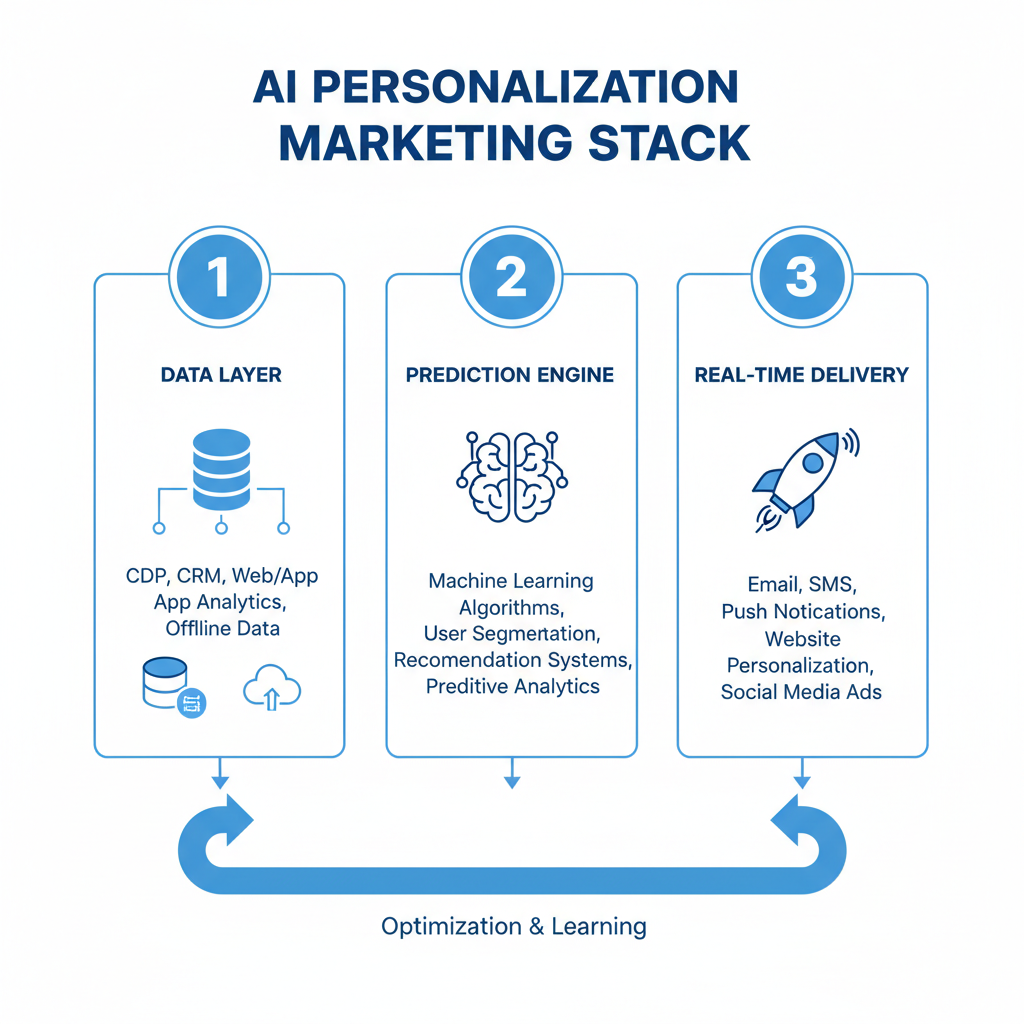
- The stack has three layers: data collection, prediction engine, and real-time delivery
- Done right, it is the highest-leverage improvement you can make to campaign ROI without increasing spend
Why Generic Marketing Is Bleeding Your Budget
The average consumer sees 6,000–10,000 brand touchpoints a day. Your ad is one of them. If it is not immediately relevant — same category they just browsed, same problem they have been searching — it disappears. Not just ignored. Gone. That is the real cost of generic marketing: not wasted impressions but wasted intent signals you could have acted on.
Across campaigns managed through Advertizingly, we see a consistent pattern: brands running static audience segments — “male, 25–34, Delhi, interested in fitness” — convert at 0.8–1.2%. Switch to behavioral clusters built from actual site events, cart actions, and email engagement history, and that number moves to 3–5%. Same budget. Same creative. Different targeting logic.
The mistake is treating personalization as a surface-level tactic (a subject line with someone’s first name) rather than a data infrastructure decision. Real personalization means every touchpoint adapts based on what the system knows about that specific person’s intent right now — not what they looked like last quarter on a demographic profile.
How AI-Driven Personalization Actually Works
There are three distinct layers to any functional AI personalization system. Most brands have the first. Few have the second. Almost none have all three working together in a connected loop.
The Data Layer
This is where most brands stop. They install Google Analytics, maybe Meta Pixel, collect events, and call it done. Raw data is not personalization. You need unified customer profiles that merge first-party behavioral data — site events, purchase history, email clicks — with CRM records, and make it queryable in near real time.
Tools like Segment, Rudderstack, and mParticle handle this. Without a clean data layer, the AI has nothing reliable to learn from — and you end up personalizing based on stale demographic proxies that do not reflect actual intent. The CDP (customer data platform) is the foundation everything else depends on.
The Prediction Engine
This is the machine learning component. Algorithms — typically collaborative filtering, gradient boosting, or deep neural nets depending on the use case — analyze patterns across your customer base to predict what a specific user is likely to do next:
- Which product they are most likely to buy in the next 7 days
- When they are approaching churn risk
- What message format will move them from consideration to purchase
- Which channel they are most likely to convert on in the next 48 hours
- What price point or offer structure will overcome their specific hesitation
Platforms like Klaviyo, Braze, and Dynamic Yield have this built in. The question is not whether the technology exists — it is whether your data is clean enough to feed it meaningfully.
Real-Time Delivery
Prediction is useless if it does not reach the customer at the right moment. Real-time delivery means the prediction engine triggers a personalized email within minutes of a specific behavior — abandoned cart at ₹4,800 — updates a Facebook ad creative based on the last page visited, or surfaces the right product on-site the moment someone lands from a specific search term.
This requires the data layer, prediction engine, and activation channels to be properly integrated. Most brands have all three systems installed but not connected. That integration gap is where most personalization ROI gets lost. See how we close it for clients through our campaign work.
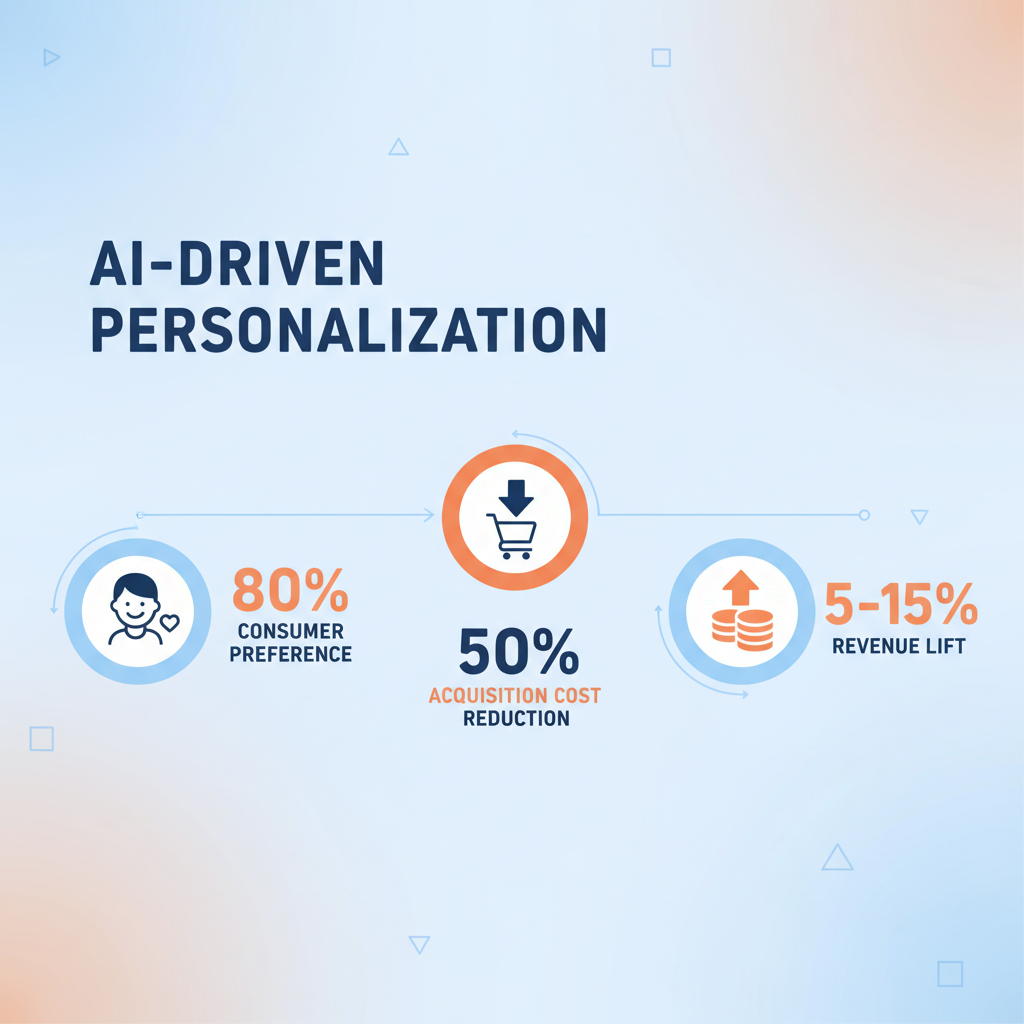
The Data Behind AI-Driven Personalization ROI
This is not a bet on a future trend. The results from personalization are already documented, and they are not marginal gains.
80%
of consumers more likely to purchase when brands offer personalized experiences — Epsilon, 2024
50%
reduction in customer acquisition costs for brands using full-funnel AI personalization — McKinsey
73%
of customers expect brands to understand their unique needs — Salesforce State of the Connected Customer
5–15%
Revenue lift from personalization at scale — plus 10–30% improvement in marketing spend efficiency. Source: McKinsey & Company
What Most Brands Get Wrong
There is a version of “personalization” that is almost worse than doing nothing. Addressing someone by first name in an email, then immediately serving them a retargeting ad for the product they bought yesterday. Or segmenting users into three buckets — cold, warm, hot — and calling that AI. It is not.
“Personalization done badly destroys trust faster than no personalization at all. If the system gets it visibly wrong, it signals that you were watching but did not actually pay attention.”
— Observed across 40+ client campaigns, Advertizingly
The three failure patterns we see most consistently:
- Data silos that never get resolved. CRM does not talk to the ad platform. Email tool does not know what the user did on-site last Tuesday. Each system optimizes in isolation and the customer gets a contradictory, disjointed experience across channels
- Over-reliance on third-party data. With signal loss from iOS updates and cookie deprecation accelerating, audience targeting built on third-party behavioral data is increasingly unreliable. Brands that did not invest in first-party data collection are now flying partially blind
- Personalizing the entry point, not the funnel. You can personalize subject lines all day. If the landing page is generic, the funnel breaks at step two. Personalization has to extend from first touchpoint through the conversion event — not just the ad or email header
Building Your AI Personalization Stack in 2026
You do not need a $500K enterprise platform. The tools have become accessible. What you need is the right architecture and clarity on which channel to start with before expanding.
Before adding new tools, map what you already have. Every tracked event, every populated CRM field, every active email sequence. Most brands are sitting on data they have never activated properly.
Segment or Rudderstack for mid-market. Every tool in your stack talks to the CDP — it becomes the source of truth for who each customer is and what they have done across every touchpoint.
Do not build the personalization engine without knowing where it outputs. Email, on-site, or paid ads each have different latency requirements and personalization levers. Start with one and go deep before expanding to the next.
“User viewed pricing page 3 times in 7 days without converting” is a trigger worth acting on immediately. “Interested in our product” is a segment that tells you almost nothing actionable. Triggers drive timely responses. Broad segments drive spray-and-pray campaigns.
Run holdout tests. Compare personalized vs. non-personalized cohorts. If you are not measuring the specific lift from personalization, you cannot optimize it — and you will eventually mistake correlation for causation in your attribution.
Use our ad budget calculator to model out channel investment before committing to a full personalization stack build. It helps size the budget question before architecture decisions are made.
Where the Highest-ROI Use Cases Actually Are
Theory is fine. Here is where AI-driven personalization moves performance metrics most reliably — based on campaigns we have run across e-commerce, SaaS, and D2C brands.
Email: Beyond the Subject Line
Brands seeing 40–60% open rate lifts from “personalization” are usually just using first names. The real opportunity is content block personalization — the actual body of the email changes based on what the recipient last browsed, what they have bought before, and what behavioral cohort the AI has assigned them to. Platforms like Klaviyo do this natively. Setup is front-loaded, but once running it requires minimal ongoing management.
We covered the full playbook in our email marketing automation guide — including how to structure behavioral triggers for e-commerce and SaaS funnels specifically.
On-Site Product Recommendations
Amazon built a significant part of its business on collaborative filtering: “people who bought X also bought Y.” The same logic — trained on your own product catalog and behavioral data — works for any e-commerce brand with sufficient transaction history. The minimum viable threshold for meaningful AI recommendations is typically 1,000+ unique monthly purchasers. Below that, the data is too thin and rule-based merchandising outperforms the model.
Paid Ad Creative Rotation
Meta Advantage+ and Google Performance Max already rotate ad creatives based on predicted performance per audience segment. The brands that outperform are not those with more creatives — they are those with creatives built around distinct intent signals. A user who clicked a competitor comparison ad needs a different message than one who arrived from a branded search query. Feed the system signal-aligned creatives and let it optimize delivery.
AI personalization generates the highest consistent ROI when applied to email content blocks first, then on-site recommendations, then paid creative rotation. Start with email: lower cost to implement, faster to measure, and the data feedback loop is cleaner than paid channels.
How Personalization Data Feeds Back Into Creative Strategy
Personalization does not live in isolation from the rest of your marketing operation. The campaigns that compound results over time are the ones where personalization data closes the loop back into creative strategy — not just ad delivery.
For example: if your personalization system shows that users who convert at highest rates consistently engaged with long-form mobile video before purchasing, that is a production budget directive for next quarter. It tells you where to put resources. Most teams do not close this loop. They run personalization as a delivery optimization and miss the upstream creative insight it generates.
This is the difference between AI as a tactic and AI as an operating intelligence. Our broader thinking on this is in our guide to AI-powered marketing — specifically how it changes campaign architecture at the strategic level, not just execution.
Want us to handle performance marketing for you?
Advertizingly runs performance marketing for growth-stage brands in the UK, US, Canada, and Australia — audits, setup, and ongoing management included.
Frequently Asked Questions
What is AI-driven personalization in marketing?
AI-driven personalization uses machine learning algorithms to analyze customer behavior, purchase history, and real-time intent signals — then automatically adapts marketing content (ads, emails, landing pages, product recommendations) for each individual. It replaces static demographic segments with continuously updated customer profiles that reflect current intent.
How much does AI personalization improve conversion rates?
McKinsey reports a 5–15% revenue lift and up to 50% reduction in customer acquisition costs from personalization at scale. Across e-commerce campaigns we have managed, switching from static audience segments to behavioral clusters typically moves conversion rates from the 0.8–1.2% range to 3–5% — same creative, same spend.
Do you need a large budget to implement AI personalization?
No. Mid-market tools like Klaviyo, Segment, and Meta Advantage+ make AI personalization accessible at ₹50,000–₹2,00,000 per month depending on data volume and channels. The real investment is setup time and data architecture — not platform cost. Most brands already have the tools and have not connected them properly.
What data do you need to start personalizing at scale?
Start with first-party behavioral data: page views, product clicks, cart events, email engagement, and purchase history. You do not need third-party data. The minimum viable dataset for meaningful AI personalization is typically 3–6 months of site behavioral data with at least 500 monthly active users generating consistent event signals.
How is AI personalization different from standard audience targeting?
Standard targeting uses fixed segments built once and updated rarely. AI personalization continuously updates each user’s profile based on new behavior and predicts their next likely action — then triggers a response in real time. It is the difference between a static demographic label and a live behavioral model that evolves as the customer does.
Final Thoughts
The brands winning on performance in 2026 are not the ones with the biggest budgets or the cleverest creatives. They are the ones whose marketing system knows more about each customer than the competitor does — and acts on that knowledge automatically, at scale, without a human manually adjusting every campaign.
AI-driven personalization is the infrastructure that makes that possible. It is an architectural decision about how your marketing operation works. The earlier you build it, the more data your models have to learn from — and the wider the gap you open between your results and everyone else still running static segments.
If you want a clear picture of where your current stack stands and what it would take to build real personalization into your campaigns, get in touch with Advertizingly. We will map what you have, what is missing, and what the ROI case looks like before you commit to anything.
For more on how we approach performance marketing at the system level, browse our marketing blog — or review what actual campaign results look like in our case studies.